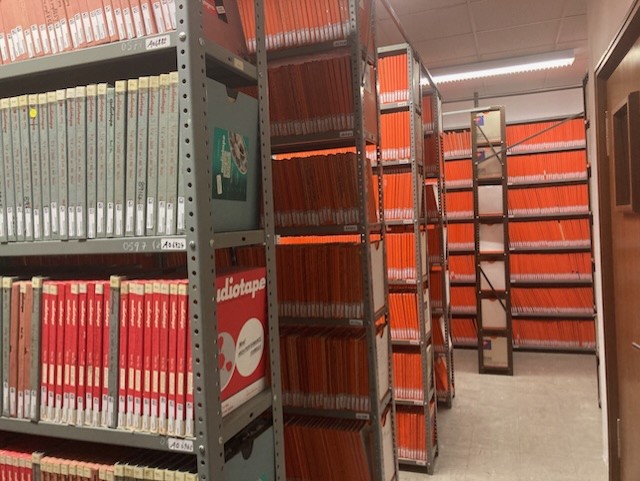
Jekyll2025-04-30T07:11:09+00:00https://sound-affairs.github.io/feed.xmlSound AffairsA project website for the Sound Affairs Project. Sounding Out the Archive - Exploring UNESCO’s Early Radio Endeavors2025-04-29T16:40:16+00:002025-04-29T16:40:16+00:00https://sound-affairs.github.io/blog/2025/archive_visitPhD Candidate Holden Carroll recently concluded his first visit to the UNESCO archives, located at the agency’s headquarters in Paris. He surveyed and collected a portion of the rich textual materials that help to account for UNESCO’s earliest uses of sound, including crucial sources related to the planning and prosecution of the international organization’s radio programme and its deployment of radio technology across a number of its early Fundamental Education initiatives. View of just one of the multiple rooms containing the analogue audio archives
With the generous guidance of archival staff, he also had the opportunity to tour parts of the headquarters basement to view the premises of UNESCO’s radio studio and the rooms that store thousands of audiotape reels––many of which have recently been digitized. This first visit was an illuminating introduction to the archive. Holden looks forward to future visits that will further engage UNESCO’s work with sound and radio into the 1960s, with a particular focus on the organization’s Technical Assistance missions.
]]>Holden CarrollSound Affairs - Sonic Histories of Foreign Relations, 1700-1990 (Inaugural workshop)2025-02-01T16:40:16+00:002025-02-01T16:40:16+00:00https://sound-affairs.github.io/blog/2025/workshopOn October 25, 2024, a group of scholars from the Netherlands and beyond gathered in Amsterdam for an engaging workshop exploring innovative approaches to studying sound, media, and cultural history. The day-long event combined theoretical presentations with hands-on exploration of digital methods, culminating in a public evening lecture at Spui 25.
The first session featured three inspiring presentations that traced different approaches to studying sonic media, both today as in the past. Following each presentation, we heard illuminating discussions with specialists Carolyn Birdsall (UvA), Rebekah Ahrendt (UU), and Holger Schulze (UCPH).
Loren Verreyen opened the morning session with an innovative presentation on analyzing podcasts at scale. Using true crime podcasts as a case study, and based on a sample of 1,1 million English-language podcasts, Verreyen demonstrated how digital methods and automated transcription can help researchers understand patterns across large collections of audio content.
Loren Verreyen giving the first talk on analyzing Podcasts at scale
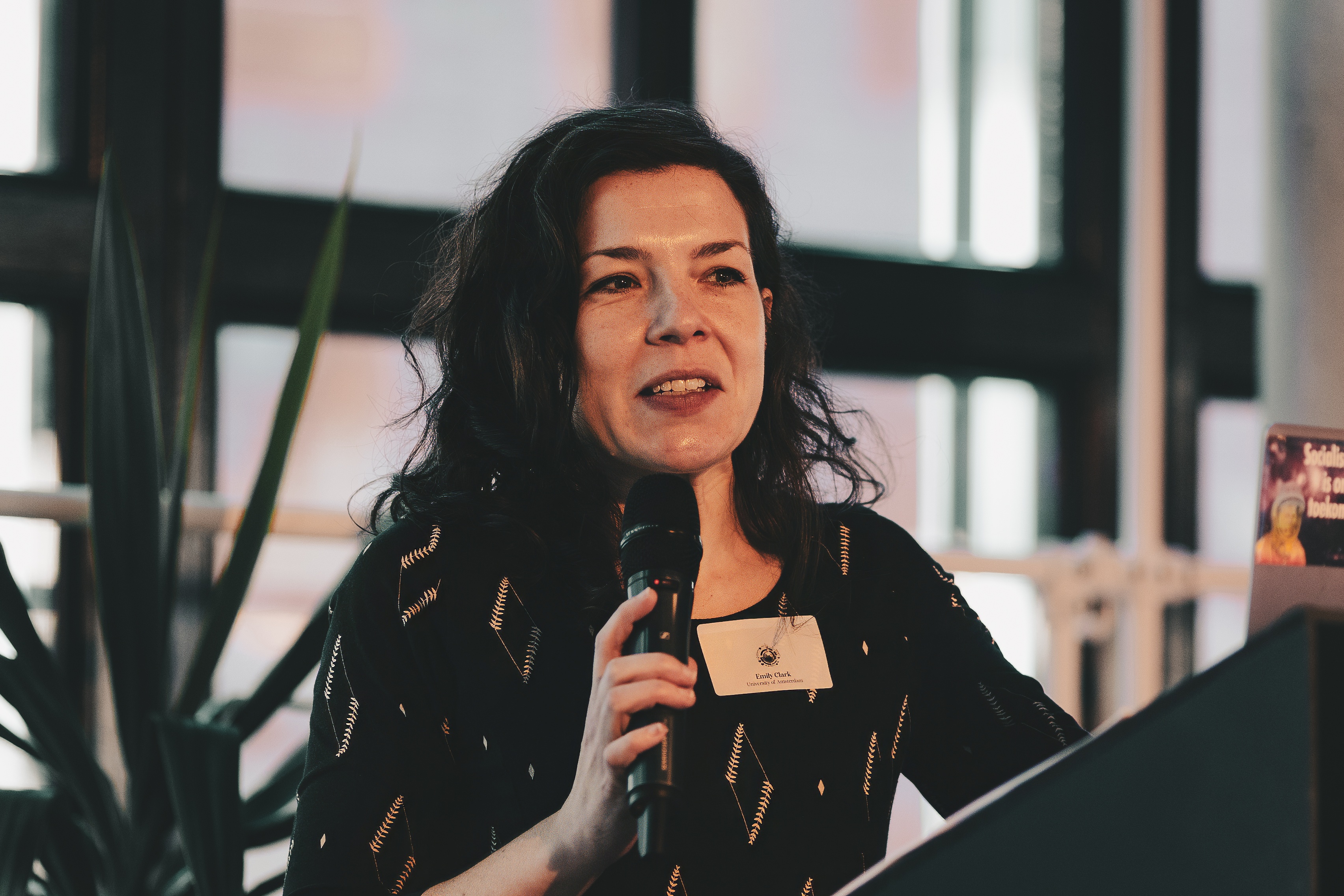
Emily Clark followed with a stimulating examination of postwar Dutch folk song recordings, held at the Meertens Institute, exploring how these sound archives were formed, what they left out, and how they were later inventoried. Her research highlighted how sound recordings have historically been used in processes of knowledge formation to construct and understand cultural identities and (colonial) self-other distinctions.
Emily Clark giving a talk on the formation of sound archives.
Holden Carroll concluded with a fascinating look at UNESCO’s uses of radio in the post-war period. His presentation examined how the organization deployed radio broadcasting as a tool for international development and peace-building, revealing the complex relationship between sound, power, and global politics.
Holden Carroll giving his presentation.
The afternoon featured an interactive workshop where participants explored practical challenges in sonic research. Divided into smaller groups, attendees discussed methodological approaches to working with historical sound recordings and strategies for finding sonic references in textual sources when recordings aren’t available. The workshop also examined emerging possibilities offered by generative AI and audio restoration software, prompting rich discussions not only about both the opportunities and limitations of these new tools, but also what future sonic technologies and software might afford.
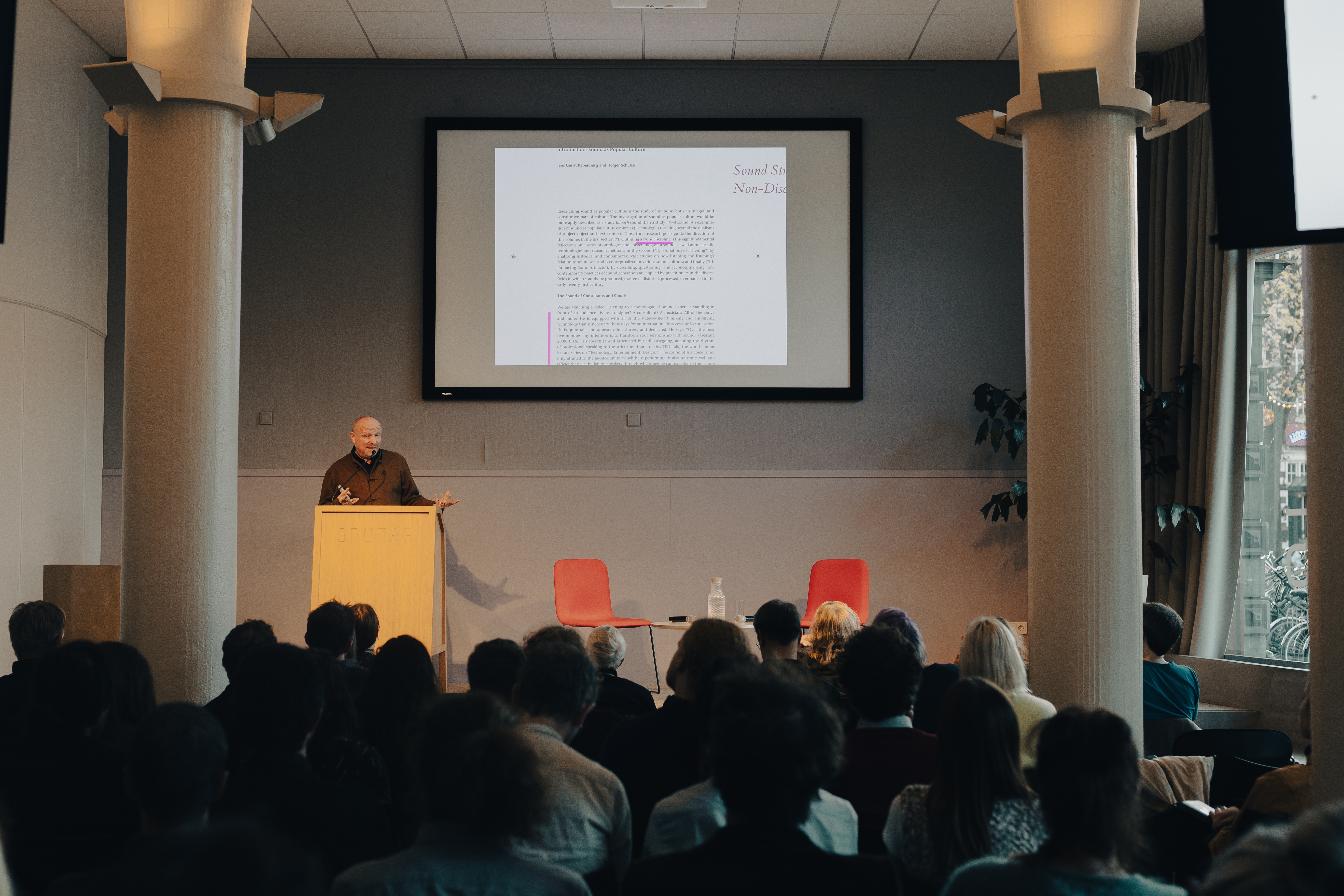
The day concluded with the inaugural lecture of the “New Directions in Sonic History” annual lecture series at SPUI25, delivered by Professor Holger Schulze of the University of Copenhagen. Schulze provided a comprehensive overview of Sound Studies’ evolution since the turn of the century, while acknowledging its deeper roots in artistic and scholarly work dating back to the 1970s. Speaking to a packed SPUI25, Schulze emphasized recent efforts to decolonize sound studies and investigate aural diversity beyond the West. A striking revelation from his talk was the deconstruction of “normal hearing,” noting that only 17 percent of people have what is traditionally considered “normal hearing” – a finding that has profound implications for how we approach sonic research.
Holger Schulze giving keynote at SPUI25.
Several themes emerged consistently throughout the day, including the importance of historical contextualization in sonic research, the potential of digital tools to enhance our understanding of sound archives, and the need to recognize diverse listening experiences and perspectives. Old questions in the field reemerged: is it possible to capture and/or reconstruct a “period ear” and how did similar sounds sounded to different people in different places in different times? Each of these sparked discussion about ongoing challenges and potential paths forward for the discipline. From folk songs to radio broadcasts, from podcasts to analytical frameworks, the event demonstrated the richness and complexity of studying sound as a lens for understanding culture, society, and history.
These and other questions will be revisited in future meetings organized by the “Sound Affairs” project team.
]]>Melvin Wevers“Easy as ABC” – Approaching the ‘Modern Sound’ in UNESCO Radio2024-07-02T09:00:00+00:002024-07-02T09:00:00+00:00https://sound-affairs.github.io/blog/2024/easy_as_abc
“The control and regulation of sound, especially the sound of the human voice, is of essential importance to the fundamental operations of the Headquarters of the United Nations.”1
United Nations Secretary-General, Report to the General Assembly of the United Nations on The Permanent Headquarters of the United Nations, 1947
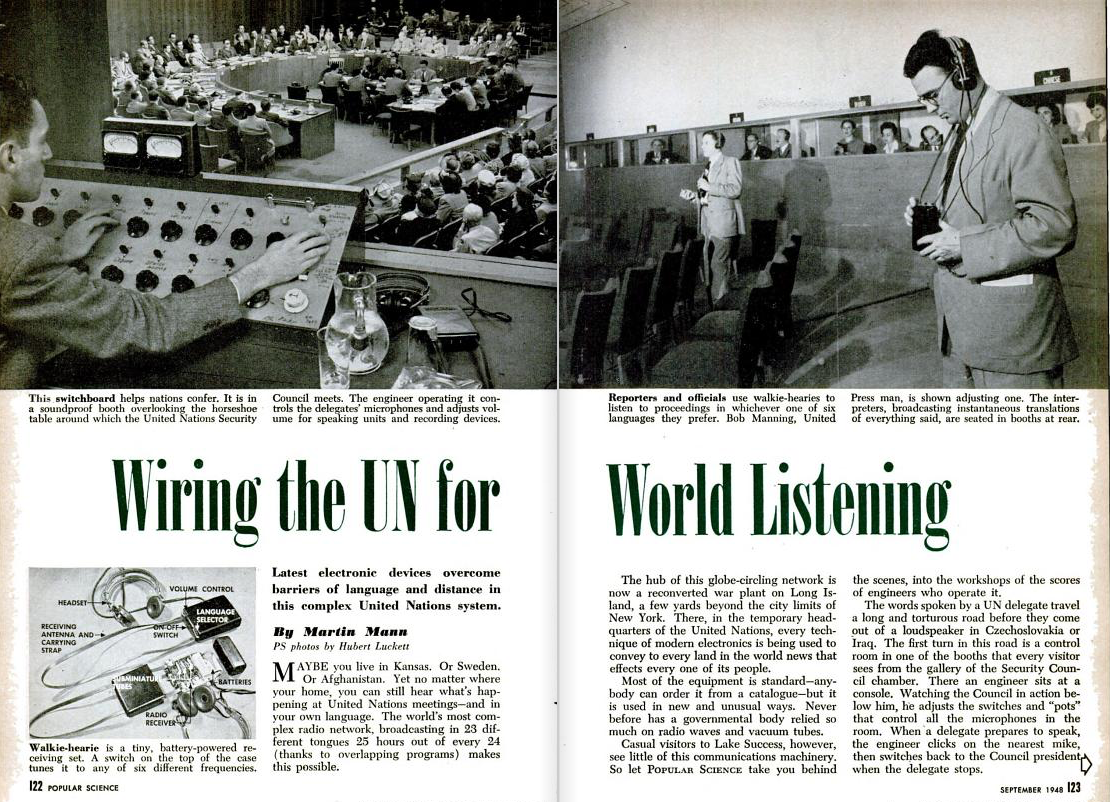
The planners of the United Nations (UN) were acutely concerned with how the new international organization would sound. In order to “strive for the highest possible value of speech intelligibility,”2 the Permanent Headquarters’ acoustically contoured assembly chambers and conference rooms were outfitted with state-of-the-art “sound-absorbing materials” intended to limit the reverberation time resulting from carefully placed microphones and amplifier arrays.3 This expertly designed4 “sonic assemblage”5 of techniques employed within the Headquarters extended to an outward-facing practice with the organization’s radio broadcasts to “the peoples of the world.”6
Spread from a Popular Science (September 1948 issue) article “Wiring the UN for World Listening.”7
As evidenced by the digitized contents of the UN Audiovisual Library, the first decades of the organization saw its multilingual production of numerous feature programs and informational bulletins that targeted an (ostensibly) international listening audience. Existing scholarly work addressing UN Radio examines its role during the peacemaking process,8 though there is apparently little to no existing work that directly analyzes this sound archive. This is a notable lacuna, especially given the extent to which the UN’s radio broadcasting project was conceived as a cornerstone of the organization’s informational mandate.9
Sonic historians have demonstrated that there is much to gain towards our understanding of the past by foregrounding meaningful sonic dynamics.10 Following such contributions to international and diplomatic history,11 the UN’s web-accessible radio broadcast archive can be approached as a collection of historical aural/oral performances that carry empirical significance. These materials can be approached as historical “sonic formations” that were productive of “political dynamics” through their meaningful ordering of sounds.12 In what follows, I sketch out a means of interpreting the historical sounds of UN Radio using digital audio analysis and reference to relevant textual records to aid a “close listening”13 approach to one of the archival recordings.
Easy as ABC
In the late 1950s, UNESCO (the United Nations Educational, Scientific and Cultural Organization) collaborated with UN Radio to produce “[a] series of 20 half-hour programmes”14 titled “Easy As ABC”15––described as an “educational series for children.”16 Each of its alphabetically themed entries featured a star-studded cast of Hollywood actors and popular singers who voluntarily performed scripted featurettes that accounted the organization’s activities, successes, and aspirations. I focus here on the second installment, “B is for Bargains” (1958),”17 which highlights UNESCO’s deployment of “experts” and “specialists”18 in the “Technical Assistance” of the world’s “under-developed regions.”19 This programme surveys such varied efforts as the establishment of a radio station in Tehran with the help of “one expert from France,” laboratory equipment and training for natural resource exploration in Pakistan set up by “[o]ne British technician sent by Unesco, ” and a “Cosmic Ray Laboratory on a mountain top in Brazil, developed with the help of Unesco experts.”20 “B is for Bargains” also showcases UNESCO’s Arid Zone Program, which endeavored (to negligible results)21 “to make more dry land agriculturally productive as well as to prevent what was believed to be the spread of deserts.”22 As its title suggests, the radio programme frames these development-oriented projects as inexpensive bargains for the organization’s member states by emphasizing the impactful results won by the efforts of a few tactically distributed experts.
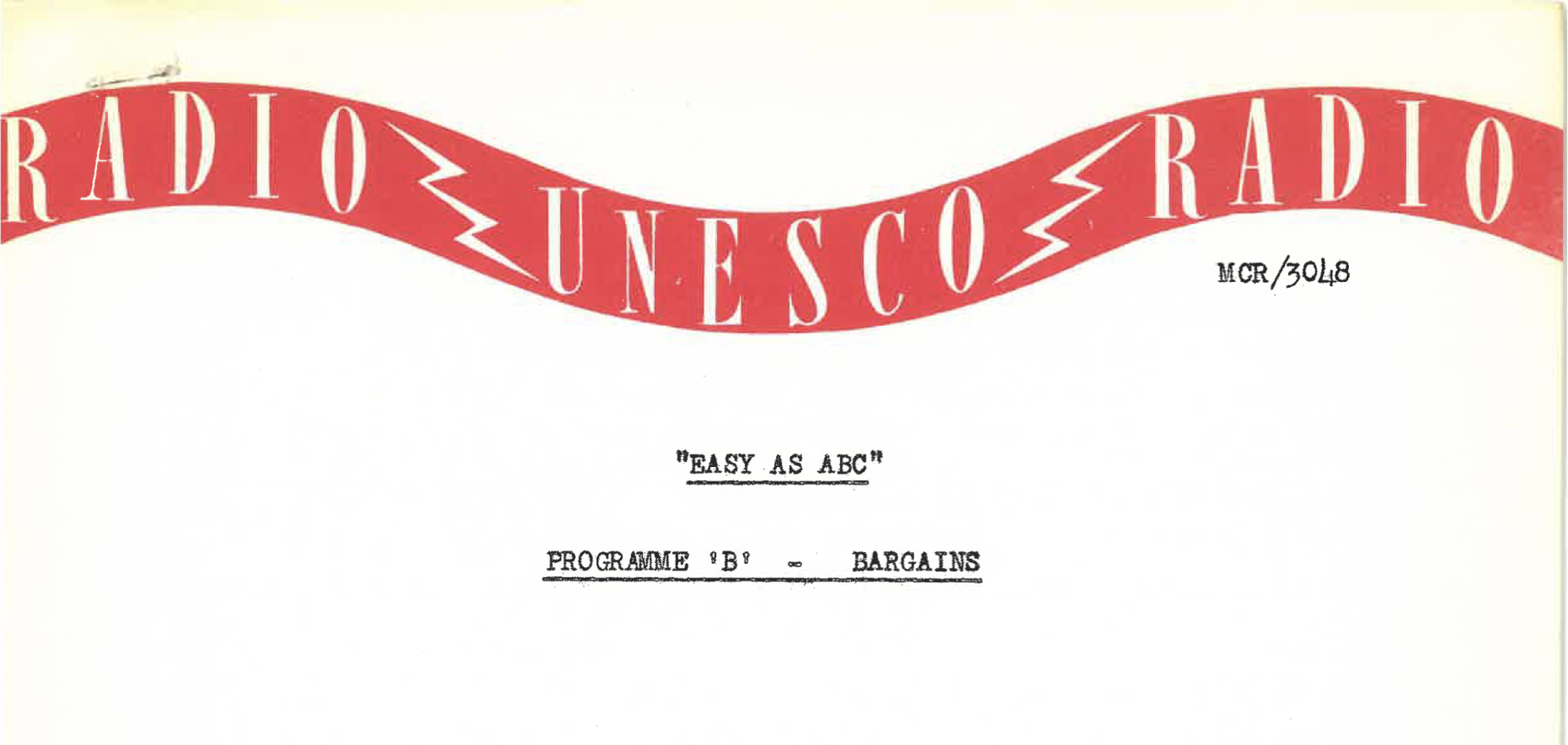
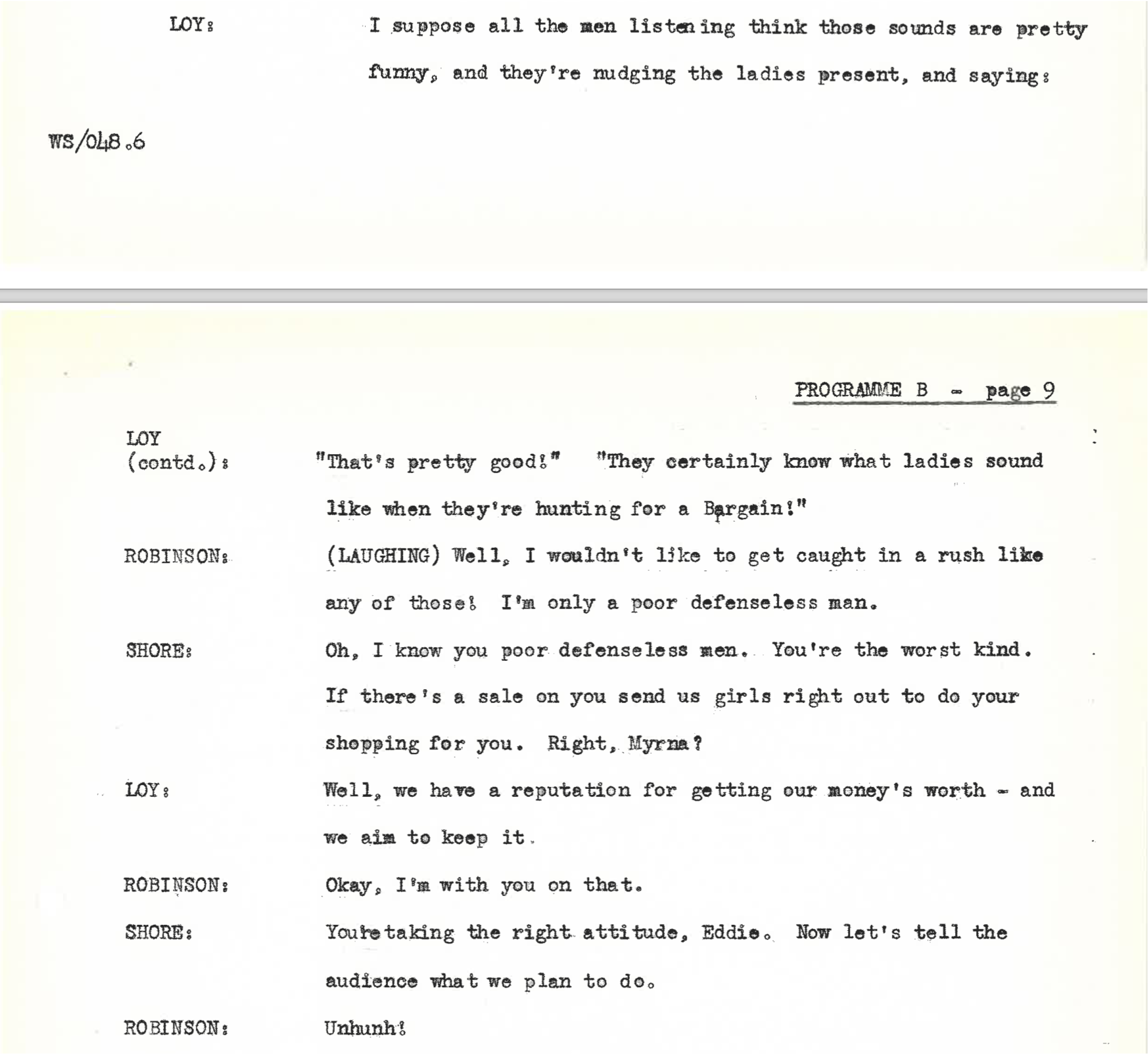
Excerpt from cover page of UNESCO Radio’s script for “Easy as ABC – Programme ‘B.’” 2
After a preamble that establishes the series’ lighthearted tone with a full-length theme song in a swing jazz style, narrators ‘Alpha’ and ‘Beta’ invite Hollywood actors Myrna Loy, Dinah Shore, and Edward G. Robinson to help explain “why B is for BARGAINS.”23 They approach this hook by playing four short “recordings” of the sounds of women “hunting for a bargain”24 during “bargain days” in four Western metropoles (Paris, Rome, London, and New York).25 With the exception of Rome, these are all locations where this radio series was produced.26 Probably best characterized as scripted skits with added background recordings, each of these short interspersions presents an auditory vignette that transports the listener to a starkly different soundscape from the relatively unadorned, “dead”27 sonic character of the radio studio: instead, a loud panoply of sounds characterizes all of these audio-visits.
I strongly encourage the reader to listen to this section––it begins at 8:00 minutes in the archived recording. Despite their respective geographic distance and the different languages heard, these sonic depictions of department stores in the four cities are very similar in terms of sonic presentation. We hear shoppers’ hurriedly anxious and/or raised voices accompanied by loud sounds––including mechanical noises, sounds of bustling crowds, coughing, intermittent squeaks, wailing babies, department store background music, bells, and reverberant echoes––in hectic auditory scenes conveying consumer fervor over temporarily reduced prices. Following R. Murray Schafer’s helpful acoustic ecology terminology, these are great examples of “lo-fi soundscapes,” where “individual acoustic signals are obscured in an overdense population of sounds.”28 In the last excerpt, from “a city in the USA” (the script specifies “NYC”),29 two women jostle over a particular commodity with increasing intensity––culminating in a violent aural cacophony of smashing glass, screaming, paper ripping, and what sounds like a gunshot––before the skit fades out to silence.
Back in the studio after a beat, our narrators use these snippets to recall the gender-stereotypical notion that women (like Loy and Shore) know a bargain when they see one.
With this innate know-how invoked, the narrators start a “demonstration in Bargains and Merchandise” where they play another set of “recordings and sound effects”31 before explaining each in turn. This sound-identification game directs the listener’s engaged attention32 to the explanation for a non-specialist, potentially skeptical public33 that UNESCO’s transnational deployments of experts have been cost-effective. The productivity of UNESCO initiatives is presented as something that can be simply heard by listening to the new sounds that have been introduced by the organization in places where there were previously none, leaving local soundscapes around the world positively transformed in the wake of (often Western) technical expertise. In one passage, Robinson characterizes UNESCO’s Arid Zone Program as “a scientific battle to stop the deserts from growing larger, to make this sound heard everywhere,”34 as a recording of rain and thunder fades in behind his voice.
From the first of these sound-examples, which represents the Brazilian “Cosmic Ray Laboratory”35 built with UNESCO assistance––a verbally unacknowledged but audible and measurable sonic juxtaposition takes place. This audio clip centers a steadily whirring machine sound, accompanied by a droning motor analogous to the sound of a forklift. While this sound could be labeled “industrial noise,”36 its aural representation is markedly more restrained than the bargain day recordings. Compared to those stereotypical depictions of aural disorder, most of these ‘UNESCO-sounds’ exhibit acute signal clarity. Portraying among other activities the spraying of DDT to prevent malaria and a diamond saw employed in Pakistan’s fossil fuel exploration, these recordings are accordingly closer in sonic character to what Schafer terms “hi-fidelity” soundscapes, where the identities and locations of sounds are more distinguishable in the relative absence of excess background noise.37 Most intriguingly, these sounds depicting UNESCO’s assistance are some of the quietest signals within the constructed soundworld of this broadcast. Evidence of this observable intention to portray the organization in ‘quiet’ terms is also found in the programme script, where Robinson is given the reading direction “(SLOWLY – VERY QUIET AND MEANINGFULLY)” for his solemn reading of the initial lines of the UN Charter.38
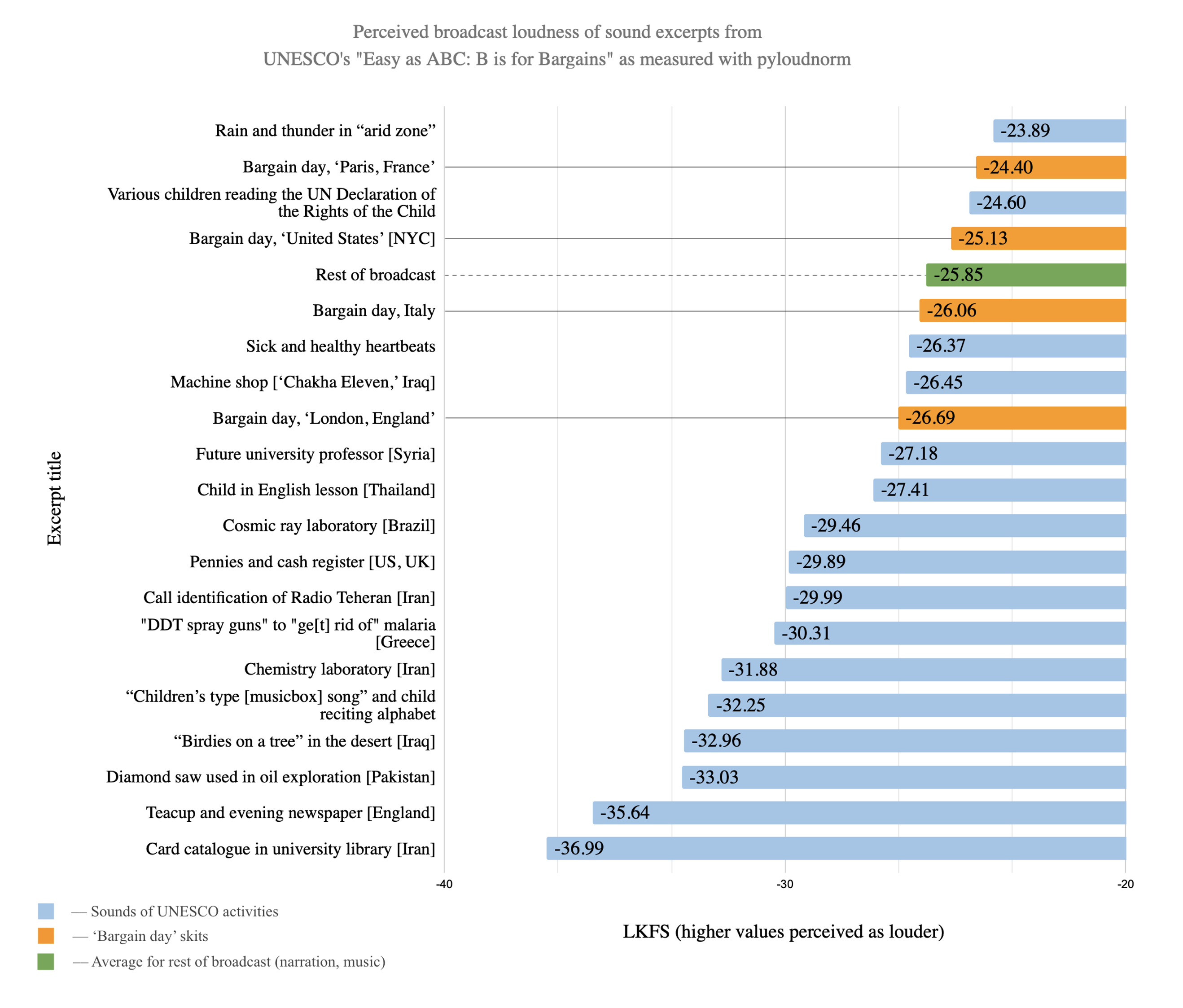
This aural positioning of UNESCO’s work as ‘quiet’ is measurable using digital techniques. To isolate each of the ‘bargain day’ recordings and the ‘UNESCO-sounds’ for measurement, I manually spliced them from the archived MP3 file and exported them (along with the remainder of the broadcast) with descriptive titles using the digital audio workstation Ableton 10. I then used ‘pyloudnorm,’ a Python package that facilitates the “ITU-R BS.1770 recommendation for measuring the perceived loudness of audio signals”39 to measure each excerpt. This technique employs a mathematical algorithm that applies frequency filters and gating techniques to sound files that “mimic the response of the head” and “reduce the influence of low frequencies” to account for human perception before calculating LKFS, a unit of loudness perception.40 This tool has at least two benefits for sonic history researchers. First, it is straightforward to use, and it runs on only a few lines of code. Second, and quite appropriate for this purpose, the signal processing algorithm that pyloudnorm automates is a standard set by the International Telecommunication Union (ITU) for “determining subjective programme loudness” of “broadcast content” within the “[r]adiocommunication sector.”41 I configured pyloudnorm to simply report an LKFS measurement for each of the excerpts that I extracted from the broadcast:
The result of this exercise is a measurement of the audible distinction between each of the sets of non-narrational sounds that give the programme its structure: the ‘bargain day’ sounds and the sounds of UNESCO’s development activities. With some exceptions, most of the sounds (in blue) that represent UNESCO are (and conceivably were) perceived as relatively quieter than both the ‘bargain day’ recordings and the rest of the broadcast (the latter encompassing, in the main, the broadcast’s spoken narration). This use of a digital analysis technique accordingly helps me to identify the presence of a meaningful distinction conveyed not through the spoken language of the broadcast, but via the sonic register. Such methods can help us begin to parse not only the intentional ordering of sounds by radio producers but also the historical conditions of listening, especially given we have an archived recording that preserves these subtle yet meaningful differences in measurable perceived loudness. The relative perceived loudness of respective features of this historical soundworld distinguish some examples of UNESCO’s work as quiet, as juxtaposed against scenes of the audibly louder, gendered dis-order of modern urban life, narratively located in four apparently prototypical Western cities.
The modern sound
This is a brief example of the type of analysis that can be done here, albeit one which raises more questions than it answers––for example why is this relative quietude and sonic isolation the sound signature associated with many of the references to UNESCO’s work in this radio programme? This observation can be linked to what Emily Thompson has dubbed the “modern sound,” a set of principles that concretized with the increased use of (electro)acoustics technologies during the early decades of the twentieth century.42 This “modern sound” is encapsulated by the preference for the removal of unwanted “noise”––encompassing both the “outside noise” of the postindustrial city and the internal reverberations of architectural space––using “soundproof[ing]” techniques refined by “architectural acoustics” practitioners.43
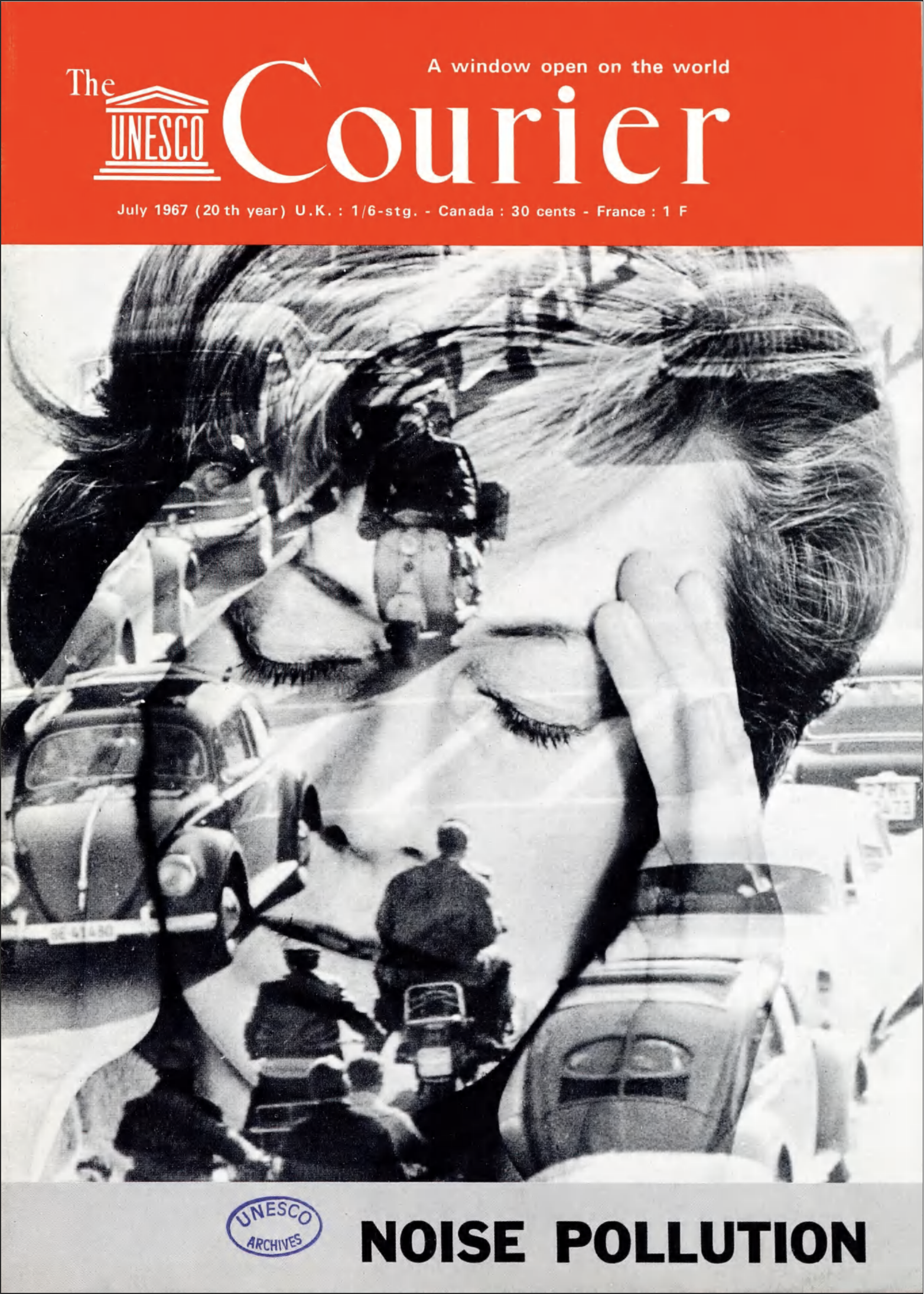
Notably, the UNESCO Courier published several articles that covered such science and technology driven approaches to noise and acoustic control, including this July 1967 issue (cover pictured).44
The ‘modern sound’ thus favors those signals that are “clear and direct.”45 The UN Headquarters’ planning documentation reflects this standard well: for example, the Secretary-General’s 1947 report notes that “acoustic treatment [in the Headquarter’s planned broadcasting studios] will be considerable since they must be very ‘dead’”46––meaning they exhibit the total dampening of undesirable room echo. Thompson argues that the modern sonic ideal “signaled the power of human ingenuity over the physical environment” through its upholding of a ‘pure’ sound signature facilitated by advancements in science and technology, and the historically contingent accumulation of expertise and best practices.47 The UN’s sustained use of these techniques of noise-limitation and signal clarity––across its architecture, audio circulation technologies, and indeed within its radio broadcasts––accordingly parallels the international organization’s comprehensive championing of scientific expertise across all areas of its administration, a tendency of that Jens Steffek has described as “technocratic-utopian.”48 All of the sounds of UNESCO’s work depicted in “B is for Bargains” exemplify the modern sound through their discreteness: each depicts one or two clearly identifiable, hi-fi sound sources not masked by spatial echoes or environmental sounds. In a recording of birdsong that is supposed to represent new “trees in the [Iraq] desert” grown following the initiative of “one expert from the UN’s Food and Agriculture Agency,”49 we don’t hear much of anything but a dry, close-mic recording of birds. With all the sound-mixing facilities of the radio studio, capable of concocting such sonic flurries as in the ‘bargain day’ recordings, a richly choreographed and complex soundscape was certainly possible. However, this was eschewed for the ‘UNESCO-sounds’ in this episode.
The ‘modern sound’ helps to contextualize UN Radio’s decision in this case to revert to austere and subdued presentation when showcasing UNESCO’s technical assistance work. The aural evidence of UNESCO’s impact is located firmly within the prevailing sonic ideal: “clear and direct” and free from ‘noise.’50 This is particularly true relative to another soundscape which listeners (and particularly women) are presumed to be familiar with: the comparatively ‘noisy’ marketplace of modern Western consumerism. The use of that gendered trope speaks to the programme’s Western origin and the intended broadcast location––it seems to be particularly aimed at an Anglo-American public as the programme also only singles out costs-per-capita for the US and England.51 This is of course a far-cry from the global public imagined in the resolution establishing the UN’s Department of Public Information.52 This case evinces a particularly narrowly Western conception of the international public that is steeped in the programme’s cold war production context. Despite its lofty universalist aspirations, UNESCO Radio was reliant on domestic producers and broadcasters (this programme was aired in the US by the American Broadcasting Corporation),53 and was at this stage embedded within the geopolitical and ideological conditions of these local infrastructures.54
Further, the relatively quiet, studio-like, and acoustically controlled presentation of the broadcast’s ‘UNESCO-sounds’ meaningfully resonates with some of the depicted activities, such as spraying DDT to “ge[t] rid of malaria,”55 and the Arid Zone Program (which is framed elsewhere officially as a battle of “Men Against the Desert”).56 Here, “the power of human ingenuity over the physical environment”57 is signaled by sound and subject alike. This observable alignment between the contemporary ideals of sound-science and the world organization’s self-representation is intriguing in this small example, although it remains be seen how these aspects manifest across a multilingual archive spanning multiple decades. Research into the UN’s wider sound and audiovisual archive and related historical materials could reveal possible resonances (and dissonances) between the international organization’s sonic and diplomatic practices and its shifting ideals––and conceivably also help to recover evidence of how, where, and in what contexts all were heard.
Author Bio
Holden Carroll is a PhD candidate at the Amsterdam School of Historical Studies at the University of Amsterdam, having previously attained an MPhil in Politics and International Studies from the University of Cambridge. He researches novel approaches to our understanding of the international system and its history.
Notes
United Nations Secretary-General, Report to the General Assembly of the United Nations on The Permanent Headquarters of the United Nations, A-311-EN (1947), available from https://digitallibrary.un.org/record/490632?ln=en, 32. ↩
For example, the eminent acoustics expert Leo Beranek was hired for the task of designing the system of “Altec loudspeakers” and “sound absorbing blankets” used throughout the United Nations General Assembly building. See description in Leo Beranek, Riding the Waves: A Life in Sound, Science, and Industry (Cambridge, MA: The MIT Press, 2008): 110–1. ↩
I adopt this terminology as it has been employed by politics and international studies scholars to encapsulate the amalgamate relations of sound technologies and human bodies. Michelle D. Weitzel, “Audializing Migrant Bodies: Sound and Security at the Border,” Security Dialogue 49, no. 6 (2018), 427. A similar term, “sonic formation,” has also been employed in international relations work with the recent contribution of Xavier Guillaume and Kyle Grayson, “Sound Matters: How Sonic Formations Shape the Nuclear Deterrence and Non-Proliferation Regimes,” International Political Sociology 15 (2021): 153–71. ↩
United Nations General Assembly Resolution 31(I), Organization of the Secretariat A/RES/13(1) (February 13, 1946), available from https://digitallibrary.un.org/record/209582, 15. ↩
Martin McMann, “Wiring the UN for World Listening,” Popular Science (September 1948): 122. Photographs by Hubert Luckett. Available here: https://books.google.nl/books?id=YCcDAAAAMBAJ. ↩
Examples include: Mahtab Shafiei and Kathryn Overton, “Peace is in the Air: Reducing Conflict Intensity With United Nations Peacekeeping Radio Broadcasts,” Conflict Management and Peace Science (forthcoming) (2023); Ali O. Nejadat and Mohammad N. Shatanawi, “The Role of United Nations’ Radio Stations in Promoting the Culture of Peace & Development in Developing Regions,” Sultan Qaboos University Journal of Arts & Social Science 5, no. 2 (2014); Anya Luscombe, “Eleanor Roosevelt, the United Nations and the Role of Radio Communications,” Athens Journal of Mass Media and Communications 2, no. 1 (2016): 33–44. ↩
See for example the discussion in the resolution establishing UN Radio as a function of the organization’s Secretariat (note 6 above, at 15, 17): “The United Nations cannot achieve its purposes unless the peoples of the world are fully informed of its aims and activities…[t]he Department [of Public Information] should actively assist and encourage the use of radio broadcasting for the dissemination of information about the United Nations.” ↩
For an enlightening introduction to this subfield, see Mark M. Smith, “Producing Sense, Consuming Sense, Making Sense: Perils and Prospects for Sensory History” Journal of Social History 40, no. 4 (2007): 841–58. ↩
See note 5 above, and Jeremy E. Taylor and Russell P. Skelchy (eds.), Sonic Histories of Occupation: Experiencing Sound and Empire in a Global Context (London and New York: Bloomsbury Academic, 2022); Damien Mahiet, Rebekah Ahrendt, and Frédéric Ramel, “Introduction: Diplomacy, Audible and Resonant,” Diplomatica 3, no. 2 (2021): 235–43 (and the other contributions to that special issue); Karin Bijsterveld, “Slicing Sound: Speaker Identification and Sonic Skills at the Stasi, 1966–1989” Isis 112, no. 2 (2021): 215–41; Ronald Michael Radano and Tejumola Olaniyan, Audible Empire: Music, Global Politics, Critique (Durham: Duke University Press, 2016). ↩
Xavier Guillaume and Kyle Grayson, “Sound Matters: How Sonic Formations Shape the Nuclear Deterrence and Non-Proliferation Regimes,” International Political Sociology 15 (2021): 158, 159. Another similar term, “soundworld,” is employed in Damien Mahiet, Rebekah Ahrendt, and Frédéric Ramel, “Introduction, Diplomacy, Audible and Resonant,” Diplomatica 3 (2021): 238–9. ↩
“Close listening,” an archival practice advanced by Anette Hoffmann, is defined in her words by “the attempt to know by ear, that is, to grasp as much as possible of the audible features of a recording.” Anette Hoffmann, “Close Listening: Approaches to Research on Colonial Sound Archives” in The Bloomsbury Handbook of Sonic Methodologies, edited by Michael Bull and Marcel Cobussen (New York and London: Bloomsbury Academic, 2021): 535. ↩
This alphabetical theme also plays on the fact it was intended for broadcast on ABC Radio in the United States. See description in archival entry, note 14 above. ↩
Phrasing cited from a 1949 Extraordinary Session document that outlines the goals and draft resolutions for UNESCO’s technical assistance program: UNESDOC, Technical Assistance for Economic Development,” 16 EX/2 (1949), https://unesdoc.unesco.org/ark:/48223/pf0000161633. ↩
There are intriguing dynamics concerning the radio listener’s active imagination. See Jonathan Sterne “Sonic Imaginations,” in The Sound Studies Reader, ed. Sterne (London and New York: Routledge, 2012): 5–6. See also Richard J. Hand and Mary Traynor, The Radio Drama Handbook: Audio Drama in Practice and Context (London: Bloomsbury, 2011): 4. ↩
See Reinhold Niebuhr, “The Theory and Practice of UNESCO,” International Organization 4, no. 1 (Feb. 1950): 3. Niebuhr cites early charges against UNESCO, including the “[US] Assistant Secretary of State George V. Allen[‘s notion] that the organization ‘had a wider public support’ and yet was ‘more widely criticized’ than any other international agency.” Allen attributed this rife criticism to the extent to which “UNESCO propaganda claims” tended to overstate the organization’s potential. ↩
Transcription and emphasis mine, from UN AV Library, “Easy,” starting at 14:08 (link in note 19). It is worth noting that this section on the Arid Zone Program appears to have been inserted after the script was written. Further, the version of the programme archived at the UNESCO Video and Sound Collections does not have this section, suggesting that there were at least two different versions of this American broadcast of the episode. ↩
For a thorough discussion on the history of the association of noise and its associative meanings in relation to industrial technology, see Karin Bijsterveld, Mechanical Sound: Technology, Culture, and Public Problems of Noise in the Twentieth Century (Cambridge, MA: The MIT Press, 2008). ↩
UNESDOC, “Easy,” 16. Also notably here, there is a sound direction to apply an echo effect (“EKO” in the script’s shorthand), though this appears to not have been used to a noticeable effect in the final mix. ↩
See Emily Thompson, The Soundscape of Modernity: Architectural Acoustics and the Culture of Listening in America 1900–1930 (Cambridge: MIT Press, 2002), 171–72. ↩
UN AV Library, “Easy.” See archival description here. ↩
It is worth noting that the Soviet Union had only joined UNESCO in 1954, four years before this recording was produced and eight years after UNESCO and UN Radio were founded. For a comprehensive survey of the USSR’s involvement with UNESCO, see Louis Howard Porter, Reds in Blue: UNESCO, World Governance, and the Soviet Internationalist Imagination (New York: Oxford University Press, 2023). ↩
]]>Holden CarrollSonic Monuments - Towards Inclusive and Dynamic Memoryscapes2024-02-08T16:40:16+00:002024-02-08T16:40:16+00:00https://sound-affairs.github.io/blog/2024/sonic_monuments“MONUMENT noun [ C ] / mɒn.jə.mənt. A structure or building that is built to honor a special person or event: in the square in front of the hotel stands a monument to all the people killed in the war.” Cambridge English Dictionary, ‘monument.’
A monument is a memory set in stone. It celebrates past triumphs and events, commemorates loss and grief, and, most importantly, builds a narrative. Monuments convey the story a community wants to publicly narrate, building a framework for what must be remembered. These memories are integral to the formation of communities: a shared past shapes a shared future. Traditional definitions of ‘monument,’ typically include three components. First, a monument is material. Second, it is a synthetic form of memory: monuments are never organic but built by people to materialize commemoration. Third, monuments are built with the purpose of commemorating something or someone.
However, as sites of memory, monuments have become contested in both academic and public debates. Who decides what to include in a ‘communal’ narrative? Whose memory do we preserve? And how do we preserve it? Monuments have been taken down, removed, defaced, and replaced. Even though monuments are fixed, the landscape surrounding them changes. What used to be a proud celebration of heroic achievement, has become a confronting reminder of the dark sides of history. The traditional monument has become the symbol of exclusive epistemologies. They are the physical manifestations of one-sided histories, artificially selecting the way we preserve and remember the past. It is time to rethink the pedestal.
Should all monuments fall? That might be too radical. But the definition of the monument is ready for some iconoclasm. Today’s monuments often transcend the contested stone assemblages of the past. From art installations to commemorative practices, this essay understands the monument as a (im)material object or practice that both reflects and shapes the way we remember the past. In what follows, I revisit the traditional study of monuments and add a sonic dimension to it. Traditionally, the visual prevails in the study and experience of monuments. Most scholarship on monuments discusses how their aesthetics relate to the memories it conveys. But we rarely think about the role of sound in our commemorative practices.
Over the last three decades, the field of sound studies has emerged as a separate field at the disciplinary crossroads of media studies, cultural studies, history, technological studies, sociology, musicology, and psychology. Working with a wide array of methodologies and vocabularies, the sound scholar takes the sonic as their analytical lens. As Jonathan Sterne explains, sound studies are not simply the product of today’s technological changes. It is rather the result of a long genealogy of thinking about the sonic dimensions of life that already started in antiquity and has now emerged as an academic field. Moreover, sound is inherently intertwined with knowledge production (Sterne 2012, 3 and 8). Therefore, a sound scholar is required to thoroughly consider questions revolving around who we hear, why we hear them, and how the sound concerned is produced. Sound is always shaped within specific epistemologies and cultural assumptions, and sound students should be careful to deconstruct both.
The relation between sound and memorialization remains surprisingly undertheorized. The first theoretical inquiries into sound and memory only set foot in 2013, when Jacques Rancière pointed to the acoustic materialization of history in the urban space, creating what he calls ‘memoryscapes.’ As Russel Skelchy and Jeremy Taylor note sound is therefore ‘not merely an object but the medium that structures remembrance’ (2023, 5). The sounds of the city frame our memories, creating memoryscapes in which our individual and collective memories come into existence.
Nevertheless, some works on sound and memory have recently been published. The volume Sound Souvenirs: Audio Technologies, Memory, and Cultural Practices, edited by José Van Dijck and Karin Bijsterveld (2009), explores how we keep ‘sound souvenirs,’ like recordings and dusty old vinyls, because they enable us to recreate sonic environments that remind us of the past. In The Memory of Sound: Persevering the Sonic Past (2015), Seán Street discusses how sound and memory are intertwined in electronic media, particularly with regards to radio. Taking a cognitive approach, Street notes that memory and sound are both a medium of self-identification, highlighting how we remember through music. Skelchy and Taylor’s Sonic Histories of Occupation: Experiencing Sound and Empire in a Global Context (2023) also provides a valuable contribution to the literature on sound and memory. Exploring how sound acts as a reminder of occupation, the volume contains several contributions on the sonic memories of occupation and the memories of sonic occupation, together showing that sound matters in understanding the histories of occupation and its aftermath.
Yet, while scholars seem aware of the significance of sound to mnemonic constellations, memory studies rarely touch upon the sonic realm. The Collective Memory Reader (2011), the standard companion for memory students, does not contain a single text on sound and memory. We have remained silent on the relation between memory and sound for far too long.
Robert Musil famously wrote that ‘nothing is so invisible as a monument’ (1930, 61). Many monuments have receded into the background, standing lonesome in neglected parks, covered in pigeon droppings, half-empty beer cans and candy wrappers. While we often think that a monument sets remembrance in stone, many warned of monumental amnesia. Ann Rigney, for example, writes that the installation of a monument ‘may in fact turn out to mark the slow beginning of amnesia and indifference’ (2008, 93). James E. Young points to the risk that we ‘encourage monuments to do our memory work for us’, which results in forgetting (2011 [2000], 374). However, as Rigney writes, ‘collective remembrance is like swimming: in order to stay afloat you have to keep moving’ (2008, 94). Memory must be performed and circulated by those who want to remember. And to do so, memory needs to be disruptive or controversial, at least to a certain extent. If not, memories fall into oblivion.
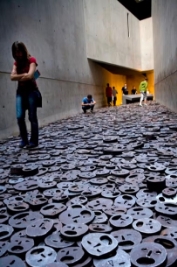
Fig. 1: Visitors engaging with Fallen Leaves by Menashe Kadishman. Photograph: Murdo MacLeod (2015). Source
But invisibility does not equal inaudibility. Monuments that incorporate sound within their visuality are likely to be more disruptive. The sonic reverberations induce the circulation of memories and foster an inescapable soundscape whose horizon goes far beyond what the visual could ever achieve. One of the greatest examples is Fallen Leaves by the Israeli sculptor and painter Menashe Kadishman, which aims to commemorate the victims of the Holocaust. The art installation, located in the ground floor void of the Jewish Museum in Berlin, consists of 10,000 iron plates in the shape of faces with open mouths. Visitors are encouraged to cross the ‘Leerstelle des Gedenkens,’ to walk over the iron faces with soundless screams and are then confronted with only the jarring sound of the iron plates jostling against each other. The sculptural piece is painful but poignant, not only because of the disorienting look of the metal disks, but more so because of the overwhelming and unsettling sonic experience. The combination of the visual with the sonic – the look of the disks and their sharp sound – results in an engaging mnemonic practice, wherein the visitor becomes part of the experience instead of a mere spectator. Being immersed in the installation means participating in its memories, whether that be memories of the Holocaust, or memories of human suffering and violence in general. In this installation, memory is performed. The combination of different sensorial experiences results in a mnemonic practice that fosters an active act of remembrance.
In its invisibility, a monument still ‘voices’ certain memories and narratives that do not necessarily apply to everyone. Especially in the case of contested monuments, such as the Hoorn monument of JP Coen, who was responsible for the murder of thousands of Indonesians in 1621, remembrance is enforced on communities to whom the pedestalled honouree is by no means a hero, but rather a painful reminder of (post)colonial violence, grief, trauma, and suffering. The traditional monument can also be problematic because of the physical space it occupies as Arno Haijtema reminds us in a recent op-ed (2023). Every mnemonic community aims for their monument to be implanted on public locations, like centres and squares (Rigney 2012, 93). The more public the space, the more outreach it seems. However, the power/space narrative is hazardous: monuments instate a hegemonic narrative in public space that otherizes the communities that do not identify with the installed mnemonic practices.
When a monument is more dynamic through, for example, a multimodality that combines the visual with the sonic, there is more room for different narratives. Whereas the visual relates to static quantities, such as stone, the sonic is more dynamic. Hence, sound (and especially silence) can potentially counter hegemonic narratives and pave the way towards ‘multidirectional memories.’ This concept, coined by Michael Rothberg (2009), refers to the idea that memories of different histories are always in dialogue with each other. Instead of commemorating one specific event or person, a multidirectional monument could commemorate different narratives at the same time.
One of the most common commemorative practices is the two-minute silence, which is often initiated to honour a specific event, such as an accident, or as a yearly tradition, like in the case of the annual Dutch commemoration of the victims of the Second World War on May 4. Although Steven Brown (2012) argues that a commemorative silence is a passive, performative act of memory that does not move towards a long-term commemoration of the person or event, I would argue for the opposite. Operating within a collective framework of silence-induced commemoration, the act of being silent is disruptive enough to induce active mnemonic circulation, but also allows multidirectional commemoration. A temporary monument is created through a short disruption of the social environment and far less exclusionary than its stone counterpart.
Sound is essential to the future of our memoryscapes. But what would a sonic monument look like? Or, more importantly, what would it sound like?
A monument is always a product of its time. Monuments should not fall, but they should be reassessed, reimagined, and reinstalled. Young coined the term ‘countermonument,’ proposing that, in response to the archaic traditional monument, countermonuments have been conceived, ‘born resisting the very premises of their birth’ (2011 [2000], 374). Also called ‘anti-monument’ or ‘nonument,’ the countermonument aims to commemorate the silenced histories, the narratives that resist authoritative memories. Adding a sonic dimension to monuments and to the study of the existing monuments allows for imagining a new type of monument, as well as a more inclusive, dynamic, and active memoryscape.
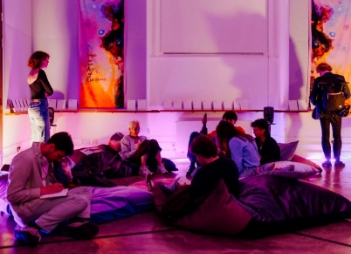
Fig. 2: Visitors preparing their message for Katriona Beales' Hope as an Act of Resistance. Picture: Sotheby's Institute of Art. (2023). Source
The first steps towards a sonic monument have already been made. In September 2023, Katriona Beales’ work Hope as an Act of Resistance: A Sonic Monument was exhibited at the Victoria and Albert Museum in London. The countermonument, commissioned by the Sotheby’s Institute of Art as part of the MA course ‘Reimagining the Monument’, consists of a sound artwork composed of people’s whispered hopes. Visitors can record their messages anonymously and are then invited to the ‘sound bath,’ a room where the visitor can listen to the whispered dreams and messages of hope. Beales stated in an interview with the Sotheby Institute that she wanted her work to reject the traditional idea of monuments as commemorating violence, but, instead, sought to create a monument that would be ‘soft, gentle, and hold people’ (2023). As Beales implicitly admits, her work does not directly commemorate anything, which makes its status as a monument debatable. However, it still prompts reflection on what monuments entail and what a sonic monument could look like.
Fig. 3: ‘A Sonic Monument,’ generated with midjourney.ai Image Generator, December 2023.
A true product of its time, as advocated for by Young’s vision of monuments, the depicted AI-generated monument is also an example of a sonic monument. Midjourney.ai created an enormous sound installation, imitating the monumental tradition of a gigantic statue of a celebrated hero put on a pedestal. The monument is not very innovative or creative, but at least incorporates sound within its commemorative practice. It also points to the main obstacle of the sonic monument: how do we continue the tradition of the monument while moving away from its problematic architectural origins?
Consequently, the key question arises: how do we create a (immaterial) sonic monument that fosters a sonic imaginary that can both frame the formulation of collective memories and allows for individual, subjective interpretations of that mnemonic narrative? It is a challenge to artists, historians, memory scholars, and urban architects to rethink the way we commemorate our past – and how we want to do so in the future. Whether through song, sound, or silence, whether sonic in its representation of the past, or sonic in its disruption of ordinary life, there are countless ways to imagine a sonic monument. Monuments can whisper and shout. Our task is to give them new voices.
Memory studies need more research into the connection between sound and mnemonic practices. Memory has an extensive, but unexplored sonic dimension. And sound offers new opportunities for monuments. Shifting the focus from the visual to the multisensorial experience of mnemonic practices allows us to conceive more inclusive, active, and dynamic memoryscapes more appropriate to the mnemonic needs of our time.
Author Bio
Laura Tacoma is a student in the Research Master in History program at the University of Amsterdam. She focusses on the relation between heritage, memory, and politics.
Bibliography
__, “monument” in the online Cambridge English Dictionary, https://dictionary.cambridge.org/dictionary/english/monument.
__, “An Exclusive Interview with Artist Katriona Beales.” Sotheby’s Institute of Art. September 2023, https://www.sothebysinstitute.com/news-and-events/news/an-exclusive-interview-with-artist-katriona-beales.
Bijsterveld, Karin, and Jose Van Dijck, eds. Sound Souvenirs: Audio Technologies, Memory and Cultural Practices. Amsterdam: Amsterdam University Press, 2019.
Brown, Steven D. “Two Minutes of Silence: Social Technologies of Public Commemoration.” Theory & Psychology 22, nr. 2 (2012): 234–52.
Haijtema, Arno. “Op standbeelden als dat van J.P. Coen Klonk van meet af aan kritiek. Wat te doen nu die weer aanzwelt?” De Volkskrant. March 7, 2023. https://www.volkskrant.nl/cultuur-media/op-standbeelden-als-dat-van-j-p-coen-klonk-van-meet-af-aan-kritiek-wat-te-doen-nu-die-weer-aanzwelt~ba39ef7b/.
Musil, Robert. The Man without Qualities. Translated by Eithne Wilkins. New York: Vintage Books, 1996 [1930].
Olick, Jeffrey K, Vered Vinitzky-Seroussi, and Daniel Levy, eds. The Collective Memory Reader. Oxford: Oxford University Press, 2011.
Rancière, Jacques. The Politics of Aesthetics: The Distribution of the Sensible. Translated by Gabriel Rockhill. London: Bloomsbury Academic, 2013.
Rigney, Ann. “Divided Pasts: A Premature Memorial and the Dynamics of Collective Remembrance.” Memory Studies 1, nr. 1 (2008): 89–97.
———. The Afterlives of Walter Scott: Memory on the Move. Oxford; New York: Oxford University Press, 2012.
Rothberg, Michael. Multidirectional Memory: Remembering the Holocaust in the Age of Decolonization. Stanford: Stanford University Press, 2006.
Skelchy, Russell, and Jeremy E Taylor, eds. Sonic Histories of Occupation: Experiencing Sound and Empire in a Global Context. London: Bloomsbury, 2023.
Sterne, Jonathan. The Sound Studies Reader. London: Routledge, 2012.
Street, Seán. The Memory of Sound: Preserving the Sonic Past. London: Taylor and Francis, 2014.
Young, James E. “From ‘at Memory’s Edge: After-Images of the Holocaust in Contemporary Art and Architecture.” In The Collective Memory Reader, edited by Jeffrey K Olick, Vered Vinitzky-Seroussi, and Daniel Levy, Oxford: Oxford University Press, 2011 [2000], 371–74.